- IPSI Newsletter
- Posts
- IPSI Live Updates! January 2025
IPSI Live Updates! January 2025
Submit your abstracts!

Alexandra Franco
January 21, 2025


🥂Happy New Year!
As we embark on the journey of 2025, the IPSI Secretariat wishes you a fulfilling year ahead.
In the spirit of collaboration, we are excited to kick off another year of shared efforts towards the sustainable management of socio-ecological landscapes and seascapes. Your dedication to biodiversity conservation and the well-being of communities around the world continues to inspire us.
We are excited to announce that the IPSI website will move to a new address: https:// satoyamainitiative.org. This transition will take place in early February, and this change is part of our efforts to enhance our online presence. We encourage you to bookmark the new site for easier access.
Submit case studies, publications, and news about your activities to be featured in the next newsletter! Your stories are valuable, and we want to showcase the incredible work happening within our community.
Let's build on the momentum of collaboration and make 2025 a year of positive impact. Thank you for being an essential part of the IPSI community.
— IPSI Secretariat
Live Updates:
Open Call for abstracts for the Satoyama Initiative Thematic Review Vol. 11
New Publication: You Are My Mountain, I Am Your Community
New Publication: Landscape Approaches for the 30×30 Target
Case study from Mudumalai Tiger Reserve, Tamil Nadu, India
Call for Abstracts for the Satoyama Initiative Thematic Review Volume 11
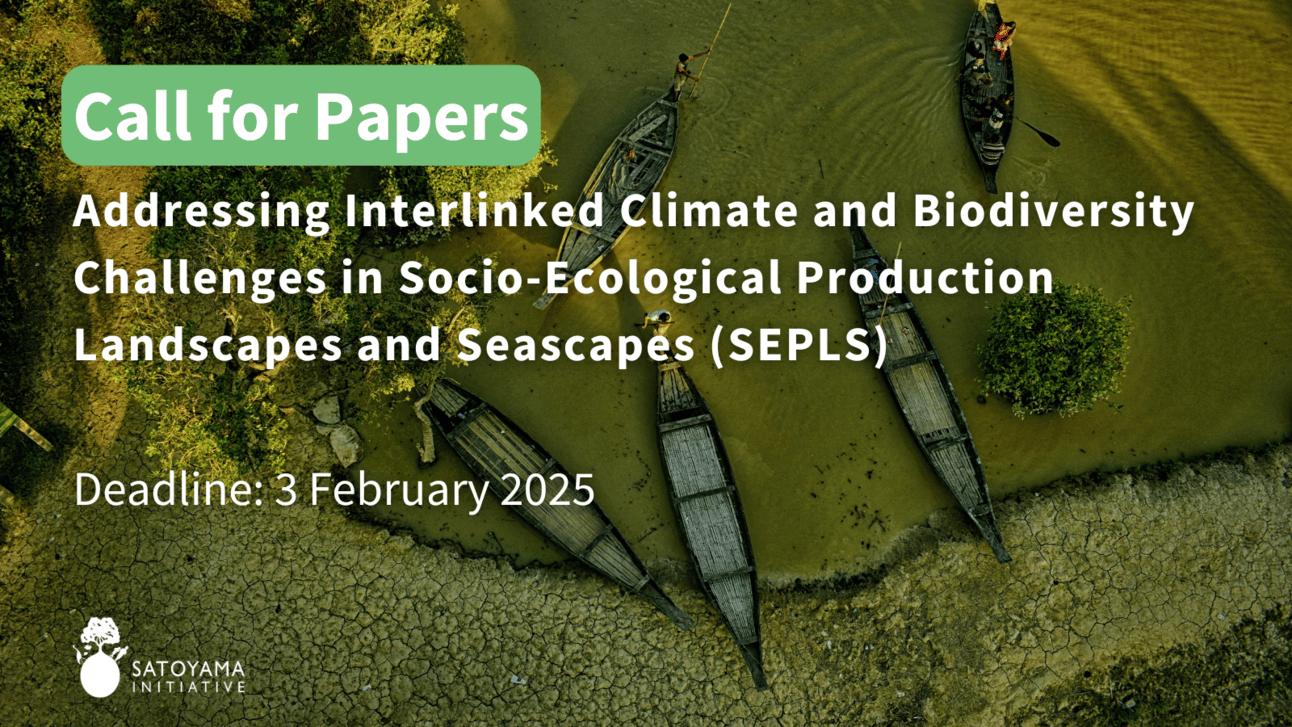
The United Nations University Institute for the Advanced Study of Sustainability (UNU-IAS) is pleased to announce a call for papers for the eleventh volume of the Satoyama Initiative Thematic Review book series on the theme Addressing Interlinked Climate and Biodiversity Challenges in Socio-Ecological Production Landscapes and Seascapes (SEPLS). We invite authors from IPSI member organizations with case studies relevant to this theme to submit a manuscript following the guidance provided in the Call for Papers.
About the Satoyama Initiative Thematic Review:
The Satoyama Initiative Thematic Review is a compilation of case studies providing useful knowledge and lessons focused on a specific theme related to “socio-ecological production landscapes and seascapes (SEPLS)”. Its overall aim is to collect practical experiences and relevant knowledge built from on-the-ground management activities and to contribute to policy recommendations. Each volume also includes a synthesis chapter clarifying the volume’s relevance to policy and academic discussions to encourage the application of lessons learned in the field. Like the last five volumes, Volume 11 will be published by Springer.
Volume 11 Theme
This volume will highlight how efforts in managing SEPLS can address climate change and biodiversity loss and ensure human well-being and quality of life simultaneously. Landscape approaches underpinning the management of SEPLS facilitate the functional integration of biodiversity with multiple benefits for people, including tangible, intangible and regulatory ones on a landscape or seascape scale. These approaches contribute to the simultaneous attainment of climate adaptation, biodiversity conservation and a good quality of life for all. This volume will look at the strategies and approaches by which multiple stakeholders collaboratively minimize trade-offs, maximize synergies and ensure human well-being and quality of life in addressing the intertwined climate and biodiversity crises.
For the past SITR volumes, please see here.
PUBLICATIONS
Researchers at the National Dong Hwa University recently published two publications.
You Are My Mountain, I Am Your Community: Rebuilding Nature-Culture Connectivity in Taiwan’s Lishan Areas
 | This publication looks at the past, present, and future of nature-culture connectivity in mountainscapes through the prism of Lishan 里山 and Sansheng 三生 concepts. The authors demonstrate their role in guiding practical efforts of the Community Forestry program and the Satoyama Initiative in the region, summarize the lessons learned and outline the ways forward. This is a chapter of volume 2 of the Montology book series. |
Landscape approaches for the 30×30 target: Potential applications and practical recommendations
 | This publication pursues three objectives. First, it suggests various area-based conservation settings where a landscape approach can be applied. Second, discusses how characteristic features and strengths of landscape approaches can be leveraged to support Target 3 of the Global Biodiversity Framework. Lastly, it provides practical recommendations for enabling their effective operationalization. This article is part of the PARKS 30.2 issue. |
CASE STUDY
Tribes, Tourism, and Sustainability: A case study from Mudumalai Tiger Reserve, Tamil Nadu, India

The Nilgiris Biosphere Reserve (Johnsingh et al., 2010)
Submitted by Integrated Development Organisation
The Mudumalai Tiger Reserve in Tamil Nadu, India, serves as a key example of balancing biodiversity conservation with community livelihoods. This case study showcases the collaboration between the Tamil Nadu Forest Department and local tribal communities to integrate eco-tourism and sustainable practices into forest management.
The initiative has provided alternative livelihood opportunities for local communities, reducing their dependence on forest resources while promoting the conservation of this critical tiger habitat. Through innovative programs and partnerships, the project demonstrates how participatory approaches can contribute to the sustainable management of protected areas.
Cover photo by Flickr on Pexels