- IPSI Newsletter
- Posts
- IPSI Autumn Newsletter 2024
IPSI Autumn Newsletter 2024
Season of the COPs
Hey there! Just a quick heads-up: we're making a few updates to our newsletter, which is why you might notice a different email address this time around. Rest assured, it's still your reliable IPSI Newsletter from the IPSI Secretariat.


🍂Welcome to the Autumn Newsletter!
This is the season of the COPs! World leaders were busy this Autumn engaged in three major UN treaty negotiations known as the Rio Conventions, focusing on biodiversity conservation, climate change, and land degradation. Key events included COP16 for biodiversity in October, COP29 for climate change in November, and COP16 for desertification in December.
In this edition, we bring you key highlights from the biodiversity and climate change COPs, IPSI’s contributions to these summits, and a preview of the upcoming desertification negotiations.
Some highlights of what you will find in this edition:
IPSI events at biodiversity and climate COPs
Upcoming events at the UNCCD COP16
Case Study: Deforestation Around the Kahuzi-Biega National Park
And more!
Contact us to submit case studies and news about your activities.
— IPSI Secretariat
Biodiversity COP16: Recognizing Indigenous Peoples and Local Communities

Photo: UN Biodiversity / Flickr
Governments convened in Cali, Colombia, for the 16th Conference of the Parties to the UN Convention on Biological Diversity (CBD COP16), also known as the biodiversity COP. The summit produced two major outcomes.
An agreement was reached to recognize Indigenous Peoples and people of African descent as key stakeholders in biodiversity conservation. Additionally, a decision was made to establish a subsidiary body for these groups under Article 8J of the Convention.
This article states that countries must respect, preserve and maintain the knowledge, innovations and practices of Indigenous and local communities that embody traditional lifestyles relevant to the conservation and sustainable use of biological diversity.
In a second significant development, COP16 delegates agreed to create a global fund aimed at collecting financial resources derived from the use of digital sequence information—genetic codes obtained from organism samples that are often shared digitally. This fund is intended for the fair and equitable distribution of these resources. Consequently, companies utilizing this information to develop products should allocate a portion of their profits to what is now referred to as the Cali Fund. Resources from this fund will be directed to Indigenous Peoples and local communities, either directly or through government channels.
Climate COP29: Historic Agreements on Finance and Carbon Markets

Photo: Vugar Ibadov, UNclimatechange / Flickr
The 29th Conference of the Parties to the UN Framework Convention on Climate Change (UNFCCC COP29) occurred in Baku, Azerbaijan. Parties aimed to negotiate a new collective quantified goal on climate finance to replace the current USD 100 billion per year goal and guidance on the operationalization of the new loss and damage fund, including eligibility criteria.
After tense negotiations, an agreement was reached that rich countries would pay developing countries USD 300 billion a year by 2035 to help them cope with the effects of the climate crisis. Becoming the biggest-ever finance commitment produced by UN climate talks.
Another notable achievement was the adoption of the decisions on Paris Agreement Articles 6.2 and 6.4, setting up a new global credit market for countries to buy and sell carbon credits with each other and companies.
Land COP16

The sixteenth session of the Conference of the Parties (COP16) of the UN Convention to Combat Desertification (UNCCD) is taking place in Riyadh, Saudi Arabia, from 2 to 13 December 2024.
UNCCD COP16 will be the largest UN land conference to date, and the first UNCCD COP held in the Middle East and North Africa region. COP16 is poised to be a game-changer, marking a renewed global commitment to accelerate investment and action to restore land and boost drought resilience for the benefit of people and planet.
The IPSI Secretariat will showcase IPSI’s work through side events focused on landscape approaches and their contributions to socio-ecological resilience and policy coherence. Check out the Upcoming Events section below for details.
IPSI Spotlight Events at COP16
Local Initiatives Toward Achieving Global Biodiversity Goals
The event focused on the IPSI’s work, featuring key publications, the Satoyama Development Mechanism (SDM) and case studies by IPSI members from the Asia and Latin American regions. UNU-IAS, IPSI Secretariat, Secretariat of the Convention on Biological Diversity (SCBD), Ministry of the Environment, Japan (MoEJ), Institute for Global Environmental Strategies (IGES), Tebtebba, Global Youth Biodiversity Network (GYBN), Ministry of Environment, Cambodia (MoEC), and Women4Biodiversity (W4B). Read more.
COP16 Side Event Spotlights Community Action for Biodiversity
The Community Development and Knowledge Management for the Satoyama Initiative (COMDEKS) under UNDP provides small-scale funding to communities for biodiversity management and sustainable livelihoods. Co-organized by the Keidanren Nature Conservation Council (KNCC), MOEJ, UNDP GEF Small Grants Programme (SGP), SCBD and UNU-IAS. Read more.
Elevating Youth Voices for Global Biodiversity Action
The event discussed ways to boost meaningful youth participation in implementing the Kunming-Montreal Global Biodiversity Framework. Co-organized by UNU-IAS and the AEON Environmental Foundation, and co-hosted by GYBN. Read more.
Landscape Approaches for Biodiversity and Peace in Colombia
The session featured experiences and insights from local organizations working to foster biodiversity and sustainable use of resources through landscape approaches in Colombia. Co-organized by UNU-IAS and IPSI Secretariat. Read more.
Landscape Management Initiatives Highlighted at COP16 Side Event
The event explored how landscape approaches contribute to implementing the Kunming–Montreal Global Biodiversity Framework (GBF). The event discussed initiatives that support integrated and whole-of-society strategies, providing practical guidance and tools. UNU-IAS, IPSI Secretariat, IGES, International Union for Conservation of Nature (IUCN), MOEJ, Conservation International, EcoAgriculture Partners, SCBD, High Ambition Coalition for Nature and People (HAC for N&P), NBSAP Accelerator Partnership and the World Business Council for Sustainable Development (WBCSD). Read more.
IPSI Spotlight Events at COP29
Event at COP29 Tackles Siloed Policymaking on Climate & SDGs
Co-organized by UN DESA and UNU and in collaboration with UNFCCC, convened leaders and experts to explore strategies for overcoming barriers to integrated, coherent climate and sustainable development action, moving away from fragmentation and policy incoherence to close the climate and SDG ambition gap while ensuring just transitions, nature protection, and resilience. Read more.
COP29 Event Highlights Strategies for Policy Coherence & Inclusion
In a highly interactive conversation, diverse actors, including youth, academia, policy organizations, and local communities, shared perspectives on operationalizing policy coherence. Using fishbowl methodology, speakers and audience members delved into challenges and opportunities related to institutional reform, equity, and maintaining focus on goals. Co-organized by UNU-IAS, the UNU Institute for Comparative Regional Integration Studies (UNU-CRIS) and the UNU Maastricht Economic and Social Research Institute on Innovation and Technology (UNU-MERIT). Read more.
UPCOMING EVENTS
Operationalizing Integrated Landscape Approaches Towards Socio-ecological Resilience
 | Time: 10 December 2024 / 11:00–12:30 AST GMT+3 This side event of UNCCD COP16 will explore the connectivity between goals related to production, development and conservation of natural resources and ecosystem functions through integrated landscape approaches. |
Leveraging Landscape Approaches Towards Policy Coherence
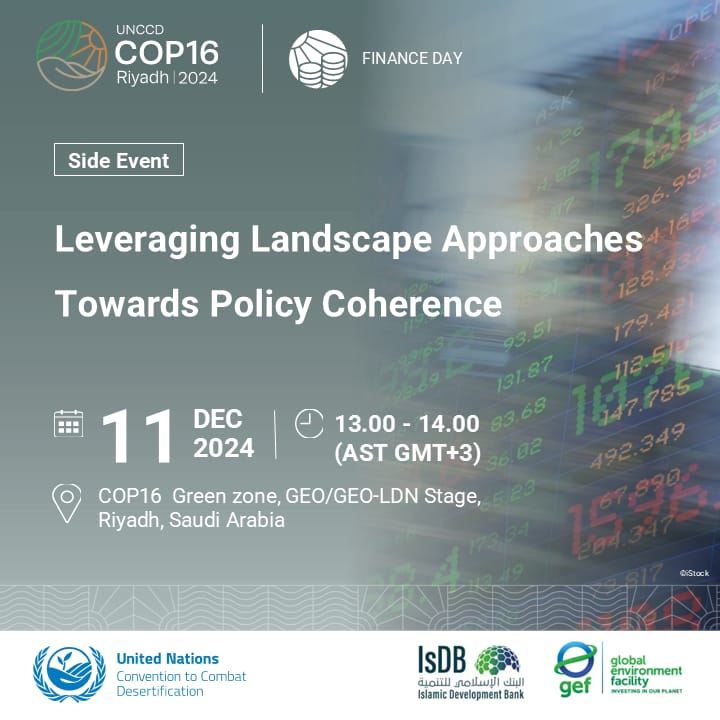 | Time: 11 December 2024 / 13:00–14:00 AST GMT+3 This side event in the Green Zone of UNCCD COP16 will illustrate how landscape approaches enable, through deliberative processes, more informed decisions related to land use that account for different types of trade-offs, and options to synergize resources, expertise and ensure equitable transactions between different actors. |
PUBLICATION
COMDEKS Phase 4: Societies in Harmony with Nature
 | The Community Development and Knowledge Management for the Satoyama Initiative (COMDEKS) was launched in 2011 as a flagship program of the Satoyama Initiative, a global initiative that aims to realize societies in harmony with nature through the conservation and sustainable management of SEPLS. COMDEKS Phase 4 was launched at CBD COP 15 with key partners including the Ministry of the Environment Japan, Keidanren Nature Conservation Council, the United Nations Development Programme and the Small Grant Programme. This brochure provides an overview of COMDEKS, highlights its previous phases, outlines its framework and key terms, and includes two case studies from earlier phases. |
CASE STUDY
Deforestation Around the Kahuzi-Biega National Park

Case study submitted by Imagine and Build the Congo of Tomorrow (ICCOD-NGO)
The case study highlights the challenges faced by this UNESCO World Heritage Site in the Democratic Republic of Congo due to illegal logging, agricultural expansion, and resource exploitation. The park, known for its rich biodiversity and endemic species, including the endangered Grauer's gorillas, suffers from significant deforestation driven by population pressure and local dependency on forest resources.
To address these issues, initiatives focus on empowering local communities through sustainable practices, reforestation, and alternative livelihoods. Efforts include raising awareness about conservation, promoting agroforestry, and enhancing the enforcement of environmental laws. These actions aim to balance biodiversity preservation with improving local living conditions and fostering community stewardship of natural resources.
Cover photo by UN Biodiversity on Flickr